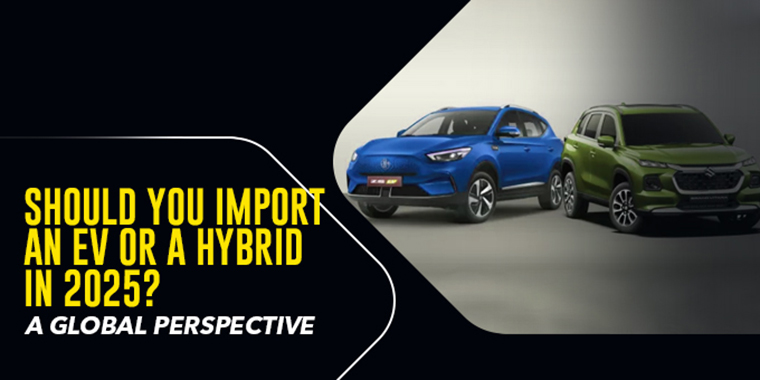
The automotive industry is in the midst of a transformative shift. While electric vehicles (EVs) have gained massive momentum, hybrid cars continue to hold their ground as practical alternatives, especially in markets where infrastructure or affordability limits full electrification. So the big question remains: should you import an EV or a hybrid in 2025?
In this article, we’ll explore this question from a global perspective, considering factors such as cost, infrastructure readiness, environmental impact, government policies, and long-term value. Whether you're an individual buyer or a vehicle importer, this guide will help you make an informed decision.
The Rise of EVs and Hybrids: A Quick Overview

In the past decade, we've seen a growing shift from internal combustion engine (ICE) vehicles to greener alternatives. This has been largely driven by tightening emissions regulations, a rise in environmental awareness, and substantial technological improvements.
EVs (Electric Vehicles) run solely on electric power and produce zero tailpipe emissions.
Hybrids, on the other hand, combine an internal combustion engine with an electric motor, offering better fuel economy and lower emissions than traditional vehicles.
Interestingly, while EVs are gaining traction in many developed countries, hybrids continue to dominate in markets where charging infrastructure is still developing. That alone sets the stage for a more nuanced import decision.
Total Cost of Ownership: Upfront vs. Long-Term Savings
Let’s begin with what matters to most buyers: the cost.
1. Upfront Purchase Price
EVs are generally more expensive upfront than hybrids due to their advanced battery systems. However, battery prices have been declining rapidly, and EV prices are becoming more competitive in 2025.
A new EV like the BYD Dolphin or Tesla Model 3 may cost more than a Toyota Prius hybrid, but the price gap is closing.
Import duties can also vary. Some countries now offer reduced or zero import taxes on EVs, making them more accessible.
2. Running and Maintenance Costs
EVs have far fewer moving parts compared to hybrids, meaning less maintenance over time. There are no oil changes, fewer brake replacements, and no transmission fluid issues.
Electricity is generally cheaper than gasoline, so charging an EV is often more affordable than refueling a hybrid.
Hybrids, however, offer the advantage of extended range and do not rely on charging stations, which is a big plus in regions with poor electricity infrastructure.
Infrastructure Readiness: Can You Charge It?
Infrastructure plays a crucial role in determining the practicality of importing an EV or hybrid.
1. Developed Markets
Countries like Norway, Germany, the UK, and parts of the U.S. have an expansive network of public chargers. In such regions, EVs are the logical choice, especially with fast-charging capabilities improving year after year.
2. Emerging Markets
In countries across Africa, South Asia, and Latin America, the EV infrastructure is still growing. Frequent power outages, lack of fast chargers, and limited technician availability make hybrids a safer and more practical bet for now.
So, before you decide, check the charging map of your country or region. If home charging is an option and you rarely need public chargers, an EV might still work.
Government Incentives and Policies in 2025

One of the most significant factors pushing buyers toward EVs is government support.
1. Tax Credits and Rebates
Many governments around the world are offering tax credits, rebates, or subsidies for EVs in 2025.
These can significantly reduce the cost of importing and registering an EV.
2. Import Duty Exemptions
Countries like Kenya, the Philippines, and Sri Lanka have slashed or even eliminated import taxes on EVs to encourage adoption.
Hybrids may also receive some benefits, but they’re typically not as generous.
3. Emissions Zones and Legal Restrictions
More cities are introducing low-emission or zero-emission zones, especially in Europe and Asia.
Owning an EV could exempt you from congestion charges, while hybrids might still incur partial fees.
Thus, understanding your local policies is essential. An EV might offer more financial advantages if your government is pushing clean transport aggressively.
Environmental Considerations: The Green Factor
Let’s not forget why EVs and hybrids became popular in the first place: reducing our carbon footprint.
- EVs produce zero tailpipe emissions, making them ideal for improving urban air quality.
- Hybrids still burn fuel, albeit more efficiently, so they’re greener than ICE cars but not as clean as EVs.
However, the source of electricity matters. If you’re in a country that generates most of its power from coal, the environmental advantage of EVs is reduced. In contrast, countries with cleaner grids (solar, hydro, wind) give EVs a significant edge in emissions reduction.
So, it’s worth asking: Is your power grid clean?
Resale Value and Market Trends

Vehicle importers also care about resale value and future demand. Here's what to consider:
1. EV Depreciation
Historically, EVs depreciated faster than hybrids due to concerns about battery life. However, by 2025, battery life had improved, and the resale market was growing.
Models from trusted brands like Tesla, Nissan, and BYD are retaining better value.
2. Hybrid Popularity
Hybrids like the Toyota Prius or Honda Insight still enjoy a strong resale market, especially in developing nations where buyers are cautious about EV reliability.
If you’re importing for resale, understanding buyer psychology in your market is key. In many regions, hybrids still feel “safe” while EVs seem “experimental.”
Technological Advancements in 2025
Another major factor to keep in mind is technology.
- EVs are getting smarter, with advanced infotainment systems, autonomous driving, and enhanced connectivity.
- Over-the-air updates are keeping EVs relevant longer without physical service appointments.
- Meanwhile, hybrids remain reliable, but often lack some of the cutting-edge tech that defines the EV experience.
If your customer base craves innovation, EVs win hands down. But if your market values reliability and predictability, hybrids remain the go-to.
So, Should You Import an EV or a Hybrid?
Choose an EV if:
- You live in or import to a country with good charging infrastructure.
- Your government offers strong EV incentives or zero import duties.
- Your local grid is powered by clean energy.
- You value low maintenance costs and modern tech.
- You plan to keep the car long-term and want zero emissions.
Choose a Hybrid if:
- Charging stations are rare or unreliable in your region.
- Gasoline is affordable and readily available.
- Your customers prioritize affordability and flexibility.
- You’re concerned about resale value in markets skeptical of EVs.
- You want a bridge between gasoline and full electric.
Final Thoughts
To sum it up, there’s no one-size-fits-all answer in the EV vs. hybrid debate. In 2025, the right choice depends heavily on where you live or operate, your budget, infrastructure, and long-term goals. EVs are undeniably the future, but hybrids still offer a valuable middle ground for many parts of the world.
If you're a vehicle importer, it's smart to diversify your inventory. Stock both EVs for forward-thinkers and hybrids for the practical crowd. This way, you're not just selling cars; you're helping people transition wisely into the future of mobility.