Automotive safety has come a long way since the early days of motoring. Back then, driving was a thrilling yet perilous experience. Today, thanks to groundbreaking innovations and persistent engineering efforts, vehicles are more intelligent, responsive, and protective than ever. But how did we get here? Let's examine the development of automotive safety in detail, from the modest introduction of seatbelts to the ground-breaking development of artificial intelligence.
The Humble Beginnings: Seatbelts and Basic Restraints
When cars first hit the roads in the late 1800s and early 1900s, safety wasn’t much of a concern. Vehicles were novelties, and accidents were relatively rare due to low speeds. However, as driving became mainstream, accidents surged, and so did injuries.
Seatbelts marked one of the earliest and most effective safety innovations. Initially introduced in the 1950s as optional equipment, seatbelts were inspired by aviation design. By 1968, the U.S. federal government mandated seatbelts in all passenger cars, and it didn’t take long for other countries to follow suit a standard that trusted automotive exporters like SBT Japan continue to prioritize when supplying vehicles worldwide.
Today, the majority of drivers use seatbelts instinctively. And with good reason there is a 45% lower chance of mortality for front-seat passengers who wear seatbelts, according to studies. Clearly, this simple fabric strap has saved countless lives.
Airbags: A Giant Leap Forward
While seatbelts were a major step, airbags took car safety to the next level. First patented in the 1950s, airbags didn’t become widely adopted until the 1990s. Why the delay? Early airbag systems were costly and occasionally unreliable.
As technology improved, so did deployment accuracy and inflation speed. Modern airbags can inflate in less than 50 milliseconds, providing a vital cushion in a collision.
Moreover, airbags have diversified significantly. While frontal airbags were standard for decades, today’s vehicles often include side, curtain, and even knee airbags. These additions provide comprehensive protection in a variety of crash scenarios.
Thanks to continuous innovation, airbags are now tailored to passenger size, seat position, and crash severity, further reducing injury risks.
Crumple Zones and Safety Cages: Engineering for Impact
You might think that a rigid car is the safest kind. However, in a collision, energy has to go somewhere. That’s where crumple zones come in.
Introduced by Mercedes-Benz in the 1950s, crumple zones are areas of the vehicle, usually the front and rear, that are designed to deform during a crash. While this might seem counterintuitive, this deformation absorbs much of the kinetic energy that would otherwise be transferred to passengers.
In contrast, the passenger cabin, or safety cage, is built to be extremely rigid. This design combination ensures that energy is managed efficiently, keeping occupants safer.
Together, crumple zones and safety cages revolutionized vehicle crashworthiness. It’s a brilliant blend of physics and design that continues to save lives.
ABS and Traction Control: From Braking to Balance
For decades, safety focused solely on protecting occupants during a crash. But what if the crash could be avoided in the first place? This question led to the development of anti-lock braking systems (ABS).
ABS prevents wheel lockup during sudden braking, allowing drivers to maintain steering control. First appearing in high-end models during the 1970s, ABS became mainstream in the 1990s and is now standard in most modern vehicles.
Closely related is traction control, which regulates engine power when the system detects wheel slippage. Together, these technologies prevent skids, maintain control on slippery roads, and reduce accident risks in challenging driving conditions.
By shifting focus from passive to active safety, ABS and traction control marked the beginning of smarter vehicle safety systems.
Electronic Stability Control: A Step Toward Smarter Systems
While ABS helps in braking, electronic stability control (ESC) goes further. Wheel speed, steering angle, and vehicle direction are continuously monitored by ESC, which was first introduced in the late 1990s. It assists the driver in maintaining control by applying brakes to certain wheels only if it detects a possible skid.
ESC can lower the probability of single-vehicle crashes by as much as 50%, according to studies. In fact, it’s considered one of the most significant automotive safety innovations since seatbelts.
By blending mechanical systems with computer-controlled responses, ESC paved the way for modern driver-assistance technologies.
The Rise of Driver Assistance Systems
As we entered the 21st century, car safety became even more sophisticated. Vehicles began incorporating Advanced Driver-Assistance Systems (ADAS) that actively prevent accidents. These include:
- Forward Collision Warning (FCW)
- Automatic Emergency Braking (AEB)
- Lane Departure Warning (LDW)
- Blind Spot Monitoring (BSM)
- Adaptive Cruise Control (ACC)
Each of these technologies enhances driver awareness or directly intervenes to prevent crashes. For example, AEB systems can detect an imminent collision and apply the brakes faster than a human could react.
Moreover, ADAS has shifted the conversation around car safety from injury mitigation to accident prevention—a profound leap forward.
Artificial Intelligence: The New Frontier in Safety
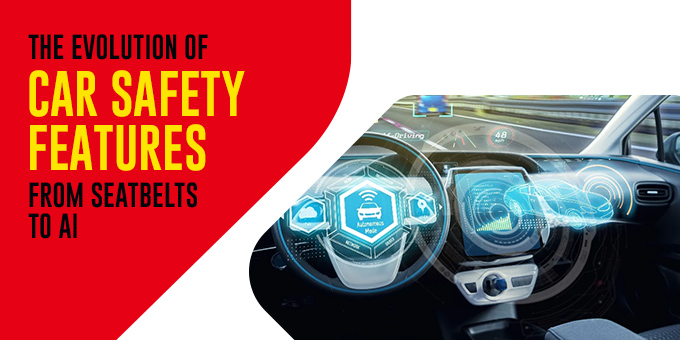
Enter Artificial Intelligence (AI)—the most transformative force in car safety to date. While current systems rely on programmed responses, AI systems learn, adapt, and predict.
Modern AI in vehicles utilizes cameras, LiDAR, radar, and machine learning algorithms to interpret surroundings in real time. This allows for:
- Object and pedestrian recognition
- Predictive behavior modeling
- Dynamic route adjustment based on traffic and hazards
- Hands-free highway driving (Level 2 and Level 3 autonomy)
Tesla, Mercedes-Benz, and other automakers are already integrating AI for enhanced safety. For instance, Tesla’s Autopilot and Full Self-Driving (FSD) systems gather data from millions of miles of driving to improve decision-making continuously.
AI not only reacts to immediate threats but also anticipates potential dangers, offering a level of foresight that human drivers simply can’t match.
Vehicle-to-Everything (V2X): Cars That Talk
Beyond AI, another game-changing innovation is Vehicle-to-Everything (V2X) communication. This technology allows cars to communicate with:
- Other vehicles (V2V)
- Infrastructure (V2I)
- Pedestrians (V2P)
- Networks (V2N)
Picture your car getting a signal from a traffic light that is about to change or from a car two cars ahead of you suddenly braking. With this information, the vehicle can slow down preemptively, avoiding a chain-reaction crash.
V2X could drastically reduce urban accidents, particularly at intersections where visibility and reaction time are limited. While still in its infancy, this tech complements AI beautifully, forming the digital nervous system of future smart cities.
The Road Ahead: Autonomous Vehicles and Beyond
All these advancements are leading toward one ultimate goal: fully autonomous vehicles. While we’re not there yet, progress is accelerating. Waymo, Cruise, and Tesla are all testing self-driving technologies with varying degrees of success.
True autonomy (Level 5) would eliminate the need for human intervention entirely. Until then, semi-autonomous systems will continue to support drivers, reduce human error, and prevent fatalities.
However, with this evolution comes new challenges: cybersecurity, ethical decision-making by AI, and regulatory frameworks. Addressing these issues is just as critical as refining the technology itself.
Final Thoughts: Safety Through Innovation
From seatbelts to AI, the evolution of car safety has been nothing short of extraordinary. Each advancement, whether mechanical, digital, or data-driven, has brought us closer to a world with fewer accidents and safer roads. As vehicles continue to grow smarter and more interconnected, safety will no longer be about surviving a crash; it will be about preventing it altogether. While technology will continue to play a leading role, its ultimate purpose is to save lives. So, the next time you buckle up and enjoy the comfort of your adaptive cruise control, take a moment to appreciate the decades of innovation behind it. Because the future of car safety isn’t just coming; it’s already here. To explore modern vehicle innovations further, check out New Harrier 2021 Features and Specs.