Choosing a new vehicle in Kenya today feels different compared to five years ago. While the roar of a diesel engine used to signify reliability, the quiet hum of electric motors is quickly becoming the new standard on Nairobi’s streets. If you are looking to buy a vehicle online, specifically from the vast and competitive Chinese market, you likely face a difficult crossroads. Should you stick with a hybrid that offers a safety net of petrol, or dive headfirst into the world of Battery Electric Vehicles (BEVs)?
This transition is not just about being green. For the savvy Kenyan buyer, it is a calculated move to dodge skyrocketing fuel prices and take advantage of generous government tax breaks. China has become the global powerhouse for both new and high-quality pre-owned EVs, making it the primary hunting ground for those seeking value. In this guide, we will break down the costs, charging logistics, and performance of these two contenders to help you decide which belongs in your driveway.
The Cost of Ownership: Upfront Prices and Import Duties
When you start your search for a used Nissan Leaf or a hybrid equivalent like a Toyota Prius on Chinese platforms, the sticker price is only the beginning. You must consider the landed cost, which includes shipping, insurance, and the Kenya Revenue Authority (KRA) taxes.
Fortunately, the Kenyan government is actively nudging toward electric mobility. Currently, fully electric vehicles (EVs) enjoy a massive advantage. While traditional petrol cars are hit with a 35% import duty, EVs are often taxed at a reduced rate of 10%. Furthermore, many pure electric models are exempt from Value Added Tax (VAT) and Excise Duty. This means that even if a used Nissan Leaf from China has a higher initial price than a petrol hatchback, the final price at the Port of Mombasa often levels the playing field.
Hybrids occupy a middle ground. They still attract some excise duty and VAT because they carry an internal combustion engine. However, they remain significantly cheaper to import than standard petrol cars. When you factor in the 40% to 50% fuel savings a hybrid offers in Nairobi traffic, the investment pays for itself within the first two years of ownership.
Charging vs. Refueling: The Logistics of Powering Your Ride
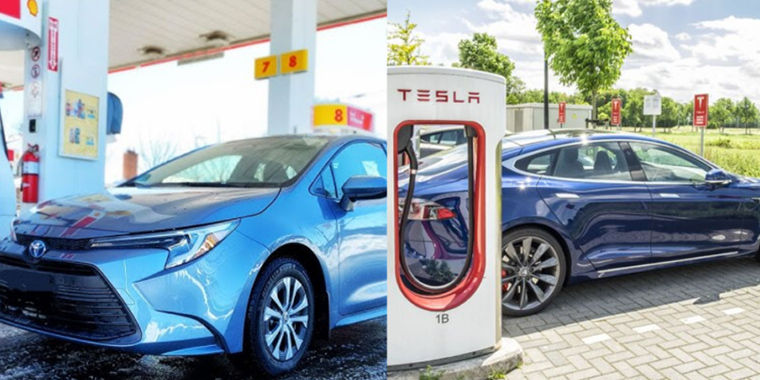
The most significant pain point for any Kenyan considering an EV is the fear of being stranded with a dead battery. Range anxiety is real, but the infrastructure is catching up faster than most realize.
If you choose a hybrid, your life remains largely unchanged. You head to the petrol station as usual, though much less frequently. The car’s battery charges itself through regenerative braking, essentially catching energy that would otherwise be lost when you slow down. This makes hybrids the no-stress option for those who frequently travel upcountry, where charging stations are scarce.
On the other hand, the used Nissan Leaf requires a proactive charging approach. Most owners do 90% of their charging at home. By installing a Level 2 wall box, you can fully charge a 40kWh Leaf battery overnight for roughly KSh 600 to KSh 900.
Compare that to the KSh 6,000+ it costs to fill a standard petrol tank, and the math becomes undeniable. For longer trips, Kenya now boasts over 200 public charging stations in major hubs like Nairobi, Mombasa, and Nakuru. Many of these are compatible with the GB/T charging standard common in Chinese imports, provided you have the right adapter.
Performance on Kenyan Roads: Instant Torque vs. Combined Power
Beyond the wallet, we have to talk about how these cars actually drive. If you have never driven an electric vehicle, the first thing you will notice is the instant torque. Because an electric motor doesn't need to rev up like an engine, a used Nissan Leaf will often out-accelerate more expensive petrol SUVs from a standstill at a stoplight.
EVs provide a remarkably smooth and silent experience. This silence reduces driver fatigue, especially during those long crawls on Mombasa Road. Because the heavy battery sits low in the chassis, the car feels planted and stable around corners.
Hybrids offer a different kind of performance. They feel like a traditional car but with a boost. At low speeds or in stop-and-go traffic, they operate silently on electricity. Once you hit the highway or need to overtake, the petrol engine seamlessly kicks in. This dual-heart system provides a total range of over 800 kilometers on a single tank and charge, giving you the confidence to drive from Nairobi to Kisumu and back without a second thought.
Maintenance: Simplicity vs. Complexity
One of the hidden wins for the electric side is the lack of moving parts. A standard engine has hundreds of components, pistons, spark plugs, timing belts, and fuel filters, all of which eventually fail. An EV like the Nissan Leaf has a fraction of those parts. You can say goodbye to oil changes, radiator flushes, and exhaust repairs. Your primary maintenance tasks will involve checking tires, brake pads (which last longer due to regenerative braking), and cabin air filters.
However, hybrids are essentially two cars in one. You have an electric system and a petrol system to maintain. While modern hybrids from brands like Toyota are legendary for their reliability, you still have to deal with traditional engine maintenance.
The elephant in the room for both is the battery. When sourcing a used Nissan Leaf from China, you must verify the State of Health" (SOH) of the battery. Kenyan regulations generally require imported used EVs to have a battery capacity of at least 80%. A well-maintained Leaf battery can last over a decade, but it is the most expensive part of the car to replace, so due diligence during the online buying process is non-negotiable.
Sourcing Your Vehicle: Why China is the New Frontier

You might wonder why so many Kenyans are looking to China rather than the traditional Japanese auctions. The answer lies in the sheer volume of production. China is the world's largest EV market, meaning the variety of New Energy Vehicles (NEVs) is unparalleled.
When you search for a used Nissan Leaf in the Chinese market, you often find units with lower mileage and higher tech specifications compared to those found elsewhere. Furthermore, Chinese exporters have become highly efficient at handling the logistics for African buyers. They understand the 8-year rule (which requires vehicles to be less than 8 years old) and can provide the necessary KEBS (Kenya Bureau of Standards) inspections before the car even leaves the port in Shanghai or Guangzhou.
Final Verdict: Which One Should You Buy?
So, which path should you take? The answer depends entirely on your lifestyle and where you do most of your driving.
Choose a Hybrid if:
- You frequently drive long distances across the country where charging infrastructure is nonexistent.
- You do not have a dedicated parking spot with an outlet for overnight charging.
- You want the fuel savings of an EV without changing your driving habits.
Choose a Used Nissan Leaf (EV) if:
- Most of your driving is within Nairobi or other major urban centers.
- You can charge your vehicle at home or at your workplace.
- You want to virtually eliminate your monthly fuel bill and reduce your maintenance costs to almost zero.
The transition to green energy is no longer a futuristic dream for Kenya. It is happening right now. Whether you choose the flexibility of a hybrid or the pure efficiency of a used Nissan Leaf. You are making a choice that is better for your pocket and the environment. By carefully sourcing from the Chinese market and understanding local tax benefits, you can land a high-quality, modern vehicle that will serve you for years to come.